The FNB House Price Index posted a contraction of
2.7% y/y at the end of June 2020, compared to
contractions of 5.6% and 3.7% y/y recorded at the
end of March 2020 and June 2019 respectively. This
brings the national weighted average house price to
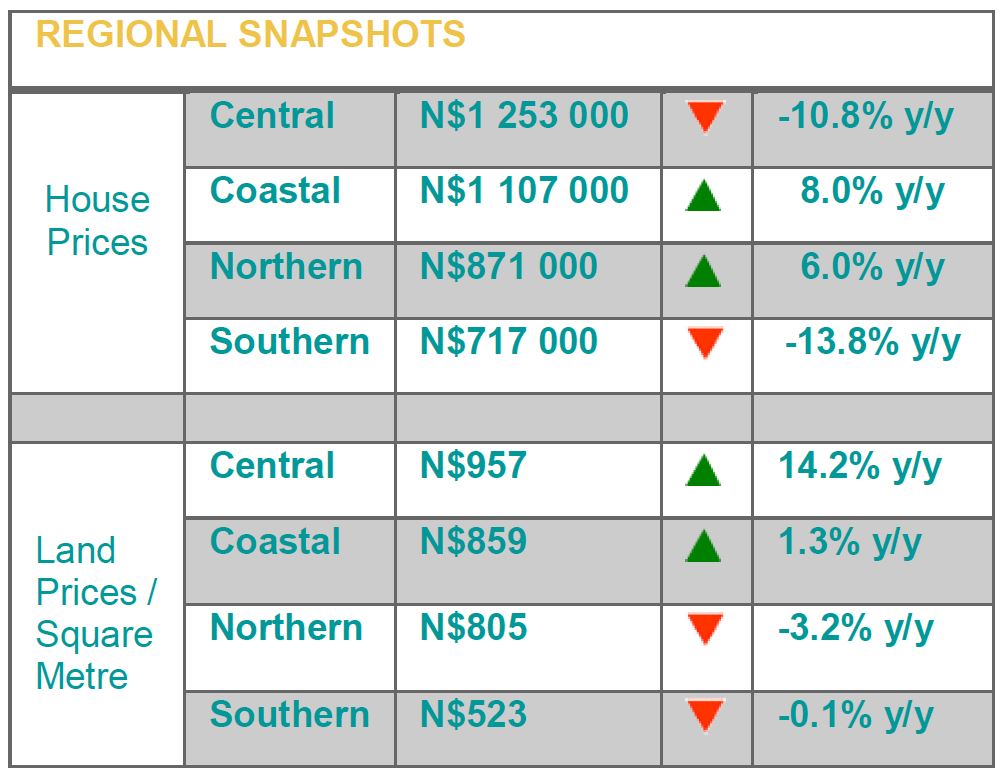
N$1 044 956 as at June 2020. House price gains were notable in the Coastal and Northern regions, registering
growth of 8.0% and 6.0% y/y respectively. Meanwhile,
double digit contractions in house prices of 10.8% and
13.8% y/y were recorded in the central and southern
regions due to affordability issues. As a result, the elevated
demand for land in the central region led to a 12-month
average price growth of 14.2% per square metre at the
end of June 2020, compared to a contraction of 13.0%
y/y recorded over the same period of 2019. This can be
ascribed to high bid prices offered for the purchase of
land mainly by private developers.
Frans Uusiku, Market Research Manager at FNB, noted
that although market sentiments may appear to point to
further declines in house prices due to expected distressed
sales, it seems that the downward trend has reached its
bottom. He mentioned two reasons: Firstly, house prices
have only registered an annual compounded growth of 6%
since 2009, which is lower than the 9% growth observed
in mortgages over the same period. Secondly, there has
been a 91% positive correlation between house prices and
mortgages since 2009. This could imply that house price
appreciation realised since the 2008 global financial crisis
was associated with a corresponding growth in mortgages.
“Therefore, from a seller’s perspective, trading activity
below the prevailing average price levels may prove
difficult due to high levels of indebtedness.”
Referring to the Regional Snapshot table
printed alongside, Uusiku added that, on
a 12-month moving average, a house in
Windhoek is now priced at N$1 188 000,
having contracted by 2.8% q/q and grown by
8.4% y/y.
“Conversely, Okahandja and Gobabis recorded annual
contractions in house prices of 3.7% and 11.5% y/y,
settling at N$764 000 and N$670 000 respectively by the
end of June 2020.”
Meanwhile, volumes traded in the central region at -4.9%
y/y as at June 2020 from 34.5% y/y registered over the
corresponding period of 2019. The medium housing
segment recorded a volume index growth of 14.2% y/y
compared to a growth of 7.5% y/y recorded in June 2019.
Houses in the higher-end market segment (large to luxury)
sold below valuation due to affordability issues. The
market for the smaller housing segment saw a continued
contraction in the volume index of 8.0% y/y as at June
2020 compared to average annual growth of 40% y/y
seen in the last two years. The revival of the small housing
market in this region would largely be dependent on the
extent of land delivery and construction of new residential
developments.
In the coastal region, Uusiku added, Walvis Bay and
Henties Bay have consistently sustained price growth. In
effect, house prices in Walvis Bay and Henties grew by
6.5% and 6.0% y/y to N$742 000 and N$776 000 as at
June 2020, respectively.
“On the flipside, selling a house in Swakopmund has
proven difficult in recent times due to economic hardship.
This is particularly true for the mining and construction
sectors which have traditionally been the key engine of
the housing market in this region. Consequently, about
90% of houses sold over the last 12 months have been
concentrated in the small housing segment – resulting in
house price contraction of 10.4% y/y to N$720 000 as at
June 2020.”
“The improvement in trading activity in the North was
more evident in Katima Mulilo, Rundu, Ondangwa and
Oshikuku which spurred growth in house prices of 60.5%,
7.9%, 7.1% and 7.1% y/y respectively.”
Uusiku pointed out that there is strong demand for housing
in the northern region, with the volume index showing
annual growth of 16.5% y/y by the end of June 2020.
“This continues to be the only region that has recorded
growth in respect of volumes traded since mid-2019,
because of the inherent dominance of the small housing
segment. The housing market recorded an annual growth
in volumes traded of 26.2% y/y at the end of June 2020
compared to 18.7% y/y recorded over the same period in
2019. However, trading activity is quieter in the medium,
large and luxury housing segments as evidenced by
continued contractions in volumes traded of 22.1%, 9.7%
and 50.0% y/y respectively.
Of the southern region, Uusiku noted that the region
represents a very small fraction of the housing market,
accounting for only 2% of overall transactional volumes
since July 2019. “Looking ahead, the property market
in the southern region is poised for advancement
considering the notable acceleration of land delivery and
decentralization of training programmes by UNAM and
NIMT in that region.”
 Frans Uusiku
Marketing Research Manager
 For more
information, please call: 061 – 299 2222 or visit
www.fnbnambia.com.na
For more
information, please call: 061 – 299 2222 or visit
www.fnbnambia.com.na 


